Showing posts with label piero della francesca. Show all posts

28 July 2011

The common-sense nihilist guide to art parahistory: An introduction

This is the presentation I gave at Massey's Postgraduate Symposium, about which we're meeting tomorrow:

This paper will demonstrate both the art parahistorical method and why figurative painting is the pre-eminent vehicle for ideas – the true conceptual art – by arguing that perspective painting proves nothing exists.

Georges Braque said that ‘The hard and fast rules of perspective which [the Renaissance] imposed on art were a ghastly mistake which it has taken four centuries to redress.’ Apollinaire called it ‘that miserable, tricky perspective ... that infallible device for making things shrink’. The early cubists realised that perspective constructions, like photographs, do not accurately represent objects as they are. Rather, they are naturalistic illusions.

However, for the purposes of this paper, let us consider figurative painting – and, in particular, perspective painting – not as a means of representing objects nor as a naturalistic illusion but as a way of dividing a painted surface to convey meaning.

This is so important that it bears repeating in bold: The aim of figurative painting and drawing, including perspective painting, is not to accurately replicate the visual appearance of things in the world. The aim is to construct meaning on a two-dimensional surface using line and colour.

Take, for example, my painting Academic art. Both title and image occupy the same pictorial plane. To further emphasise that the painting is a pictorial construction rather than a naturalistic illusion, I use a continuous line to enclose the forms, which I’ve simplified, and bright non-naturalistic colours.

People sometimes ask me why I make my hair ‘ginger’ in self-portraits. I usually answer that people’s skin isn’t yellow either:

A useful comparison is with heraldry. In a heraldic coat of arms, conventions dictate that certain divisions of the surface, such as quartering, convey a specific meaning – in the case of quartering, a merging of two or more different coats of arms through marriage or other alliance:

Similarly to heraldic quartering, a perspective painter such as Masaccio used the conventions of perspective to divide the surface of a painting such as The trinity to convey specific meaning:

Through perspective, God, Jesus, Mary, and John appear behind the picture plane and the donors and the skeleton appear to be in front of the picture plane. Although the donors and skeleton are securely located in space,* the figures making up the trinity are not. Their depth is indicated only by their size – a sly ‘fuck you’ to the older tradition of using size to indicate the importance of figures.

[*Because of botched restorations, it is no longer possible to establish the skeleton’s position in space. However, it is reasonable to assume that it was possible when Masaccio painted it. It is also reasonably likely that that position was directly underneath or in front of the donors. The inscription on the skeleton translates as ‘What you are I once was, and what I am is what you will become.’]

In The trinity, Masaccio used perspective to create a separate pictorial space. The way that space interacts with the space occupied by donors, skeleton, and viewer symbolises the supposed interaction of the spiritual with the material in Christian mythology. ‘Masaccio’s differentiation in depth between the all-too-mortal world this side of the plane and the indisputably spiritual realm inhabited by God, Christ, Mary and John is an act of high genius. A new spatial technique has simultaneously been mastered technically and locked into the meaning of the picture in a way which only a few artists have since equalled.’ (Kemp, 21.) As we shall see, one of those artists was the stone cold avant-garde genius Piero della Francesca, the best painter of the 15th century.

It was because of paintings such as The trinity that Leonardo said ‘Painting is a thing of the mind’ – a conceptual art – which I prefer to translate as ‘Painting is a mental thing.’

It is important to note that neither Masaccio nor Piero was a slave to the ‘hard and fast rules’ of the perspective systems they used. Where the system delivered a result that would look wrong, they painted what looked right instead. This is something that Uccello, in his enthusiasm, often neglected to do, ending up looking like a horse’s arse.

We know that some form of perspective was known to the Ancients from fragments of paintings and references in written texts. However, the first documented use of it is Brunelleschi’s famous demonstration.

Brunelleschi kept his method of perspective construction secret. The first documented method for constructing perspective, also based (albeit roughly) on a mathematical rule, was published by Leon Battista Alberti in his book De Pictura in 1435. He published this book originally in Latin and again in 1436 in the vernacular as Della Pittura. Most painters of the time could not read Latin.

Since Masaccio’s Trinity was painted around 1427–28, it is likely that Alberti did not invent his method – the ‘legitimate construction’ – but rather documented and possibly formalised the method used by contemporary painters. By linking perspective to mathematics and the science of optics (perspectiva), Alberti argued that painting was the intellectual equal of the traditional subjects of a humanist education, such as music and astronomy (at the time indistinguishable from astrology).

In the early 15th century, painting was considered a craft performed by artisans. Because they were mostly paid for the materials they used, it was not uncommon for painters to be paid less for a painting than the carpenter was paid for the frame around it. And because the most expensive materials were gold leaf and the lapis lazuli that makes blue, these materials tended to predominate – and be the thing most valued – in the paintings produced under those contracts.

The arguments put forward by Piero and Alberti transformed the way painting was considered. In contrast to the generation before them – and their more slow-witted contemporaries – avant-garde painters such as Piero negotiated contracts where they were paid for ‘the skill of the hand’. Their paintings were valued not simply for being ostentatious displays of wealth but rather for being complex conceptual objects.

As Piero della Francesca wrote, in one of the first historical instances of avant-garde trash-talking of the conservative academic opposition, ‘Certainly many painters who do not use perspective have also been the object of praise; however, they were praised with faulty judgement by men with no knowledge of the value of this art.’

Piero wrote this in De prospectiva pingendi (On perspective for painting), which was written to be used by apprentice painters, as opposed to Alberti’s book, which was written to explain and justify perspective in general terms to patrons. It seems academics have always focused exclusively on the requirements of those funding them!

Despite its spurious appearance as a manual and its translation into the vernacular, Alberti’s book does not provide enough information to actually construct his scheme. Believe me, I’ve tried! In contrast, in De prospectiva pingendi, Piero set out his method for constructing perspective in rigorous detail. In doing so, he also incidentally provided the first ever mathematical proof of perspective:

In his introduction to the third book of De prospectiva pingendi, Piero argued for perspective on two fronts. The first was a technical argument. The second boiled down to the argument that the Ancients used perspective, and they knew what they were about, so you might as well too: ‘By following this practice, many ancient painters acquired immortal fame. Such as Aristomenes, Thasius, Polides, Apello, Andramides, Nitheo, Zeusis, and many others.’

They cared about such stuff in the Renaissance.

Piero’s technical argument for perspective was a bit more involved – and relevant:

‘[B]ecause [figurative] painting is nothing if not demonstrations of surfaces and bodies degraded or magnified on the limit [i.e., the picture plane], placed like the real things seen by the eye as subtending different angles on the said limit, and because for any quantity some part of it is nearer the eye than another, and the nearer part always presents itself as subtending a greater angle than the further one at the assigned limits, and since it is not possible for the intellect to judge for itself of their size, so I say it is necessary [to use] perspective, which distinguishes all quantities proportionately, as a true science, demonstrating the degradation and magnification of all quantities by means of lines (Field, 163).’ (Emphasis added.)

That last phrase can also be translated as ‘by the force of lines’.

Now, to the casual glance, it may seem as if Piero is justifying perspective on the grounds that it provides a convincing illusion of the real appearance of things. However, that is not the case. As is made clear in the propositions and theorems comprising the first two books, Piero is arguing that perspective is a true science – that is, that it contains a truth about the world – because it ‘distinguishes all quantities proportionately’ and constructs bodies placed on the picture surface ‘like the real things seen by the eye’ using lines.

In other words, perspective construction uses the same mathematical laws that we use to see objects in the world. Those mathematical laws are the truth about the world that perspective contains, not the illusions it can produce.

In his paintings, Piero consciously played down the illusionism that perspective can cause. In fact, many of his paintings do not use perspective at all. Perspective is merely one tool in his arsenal. When he did use it, he was well aware of the robustness of the perspective construction when viewed from non-ideal positions. It is often physically impossible for the viewer to stand in the ideal viewing position used to construct the scheme, and Piero realised that, within certain limits (which he mathematically defined), it doesn’t matter.

In both Piero’s and Alberti’s systems, the ideal viewing point is directly opposite a point inside the picture. However, paintings in the 15th century, such as frescos and altarpieces, were often so high on walls that the actual viewer was well below the bottom of the picture (or, more rarely, above the top of it).

In such circumstances, Alberti, being an academic rather than a practising artist, prescribed somewhat arbitrarily that the ideal viewing height be the eye height of a standing figure in the picture. Piero, being a painter, gives no prescription on how to deal with the problem in his writings.

The solution he adopted in his paintings, however, is more sophisticated than Alberti’s prescription. When the pictures will be seen from below, Piero places the ideal viewing point (and thus horizon line) below the eye height of standing figures in the picture, so that the perspective is seen from below. In the rare situation that the picture will be seen from above, Piero does the converse – he places the ideal viewing point above the eye height of a standing figure in the picture, so that the perspective is seen from above.

In his paintings, Piero used perspective in specific circumstances and for specific ends. The most important of those ends, like that of all the tools he used, was to construct meaning through line and colour on a flat surface – to say something about the world as he saw it.

In The resurrection, painted for the city hall in Piero’s home town and now that town’s coat of arms, the soldiers guarding Christ’s tomb and the columns of the architectural frame are seen from below, as is Piero’s practice when the picture is high on a wall. However, Jesus** clambering out of his tomb is shown front on, not in perspective. Like Masaccio’s Trinity, Piero has used his perspective scheme to create two separate spaces – the spiritual and the mundane:

In Piero’s Resurrection, the risen Christ confronts the viewer directly, no matter how lowly they may be or what their position is. All through the use of lines.

[**I didn't mention it in my talk, but I should note that soldier covering his eyes also appears to not be in perspective. That he is covering his eyes and not in perspective seems to be related.]

Similarly to Masaccio and Piero, but on a much more modest scale and to quite different ends, I have tried to incorporate two separate spaces in Painting. The pictorial space of Painting contains, as well as the perspective space occupied by the torch, the abstract space created by the black area at the top. These spaces operate with the light in the torch – a reflected external light rather than one emanating from the torch bulb.

Piero was a Neoplatonist. His use of perspective was all about translating the ‘perfect’ world of ideal forms into the ‘degraded’ world of appearances for particular religio-magical purposes that I will explore in my discussion of Piero’s Baptism (which is probably the best painting in the world).

Piero was completely right that perspective is a true science. However, he was completely wrong in what that truth is.

This is the thing with the avant-garde. The black square is the conduit for the intertemporal avant-garde thought virus through the ur-dimension, and the transdimensional telepathic contact can be patchy. Each historical manifestation interprets that contact using the categories and concepts available in the society it inhabits. However, we’re not here to talk about that.

According to both Piero and Alberti, the first step in constructing a perspective scheme is locating the viewer in relation to the space to be portrayed. Both methods recognise that the spatial relationship between objects is determined by the position of the viewer.

That is, an object's position in space is not absolute but relative to other objects from a given point of view. Space is relative.

As Kant points out, this means that perception of space (and time and causality) is not a property of the world but an a priori property of the viewer's mind. All objects that we can perceive exist in space and time, and have causes and effects. We can only perceive objects in those terms – any object not in space, in time, and subject to causality would be unknowable. This means that space, time, and causality are conditions that must be met for us to perceive an object.

As Kant says, ‘By means of outer sense, a property of our mind, we represent to ourselves objects as outside us, and all without exception in space. In space their shape, magnitude, and relation to one another are determined or determinable (Leech, 34).’

But things-in-themselves are not dependent on the conditions we have for perceiving them. Those conditions are properties of our minds, not of the things. Space, time, and causality are subjective framing devices with which we structure our sensations and combine them into the coherent world we observe. The world we experience, the world of appearances, is dependent on the properties of our minds.

Kant asks ‘Geometry is a science which determines the properties of space synthetically, and yet a priori. What, then, must be our representation of space, in order that such knowledge of it may be possible?’ Kant’s answer is that it ‘must be found in us prior to any perception of an object, and must therefore be pure, not empirical, intuition’, which is ‘the only explanation that makes intelligible the possibility of geometry, as a body of a priori synthetic knowledge.’ (Leech, 36.)

It is a symmetrical, reciprocal relationship. The viewing subject gives the world coherence through perceiving causal relationships in space and time. In turn, perceiving the world as coherent gives the subject coherence.

However, Kant continues, neither the subject nor the world is a coherent unity. Both subject and world are made up of contradictory elements. Because the world of appearances is unreal and illusory, and it has a reciprocal relationship with the self, then the self too is unreal and illusory. Any apparent unity is an illusion produced by the mind. Neither self nor world exist.

This is the true science that perspective contains. Perspective painting encodes the process by which both self and world are fictively constructed. This is the esoteric meaning behind the exoteric meaning of the perspective painting’s ostensible subject matter.


Perspective painting proves nothing exists.

So, in conclusion, I hope that I have demonstrated how the art parahistorical method sits beside, or perhaps beyond, art history by examining the hidden connections between things, the intertemporal rather than the historical connections – in this case, between Piero’s and Kant’s conception of space as finite Aristotelian extension. How these conclusions are affected by non-Euclidian relativistic space will be explored in my discussion of the alchemico-magical operations of Friedrich Nietzsche and Francis Picabia (the best artist of the 20th century).

As an intertemporal avant-garde artist, I use these art parahistorical connections in my own work. For example, the viewer’s relationship with my paintings is very important. I use standard mass-produced canvases that are about the size of the human head and with which the viewer can have an intimate conversation. As a social species, we have, after all, evolved to respond to the faces of people standing in front of us. Therefore, when hanging a show, I try to replicate that experience, with specific exceptions for specific pictures (see here and here).

For my exhibition at the Ivan Anthony Gallery, This has to do with me, we hung The fall and Modernism high and Conceptual art low, so that viewing height could affect the content of each picture. I also plan to make certain consequences of one of Piero’s perspective construction methods an integral part of my next show at the Robert Heald Gallery. You’ll have to wait to see how.

List of books

Banker, James R., The culture of San Sepolcro during the youth of Piero della Francesca, United States of America: University of Michigan Press, 2003.

Baxandall, Michael, Painting and experience in fifteenth century Italy, United Kingdom: Oxford University Press, 1988.

Baxandall, Michael, Patterns of intention: On the historical explanation of pictures, United States of America: Yale University Press, 1985.

Calvesi, Maurizio, Piero della Francesca, United States of America: Rizzoli International Publications, 1998.

Field, J.V., Piero della Francesca: A mathematician’s art, United States of America: Yale University Press, 2005.

Ginzburg, Carlo (trans. Martin Ryle and Kate Soper), The enigma of Piero, United Kingdom: Verso, 1985.

Kemp, Martin, The science of art: Optical themes in western art from Brunelleschi to Seurat, United States of America: Yale University Press, 1990.

Lavin, Marilyn Aronberg, Piero della Francesca, United Kingdom: Phaidon, 2002.

Leech, Peter, ‘The painting of philosophy: Space, perspectivalism, representability and consciousness’ in Mehigan, Timothy J. (ed.), Frameworks, artworks, place: the space of perception in the modern world, Netherlands: Rodopi B.V., 2008.

Levey, Michael, Early Renaissance, United Kingdom: Penguin Books, 1991.

Wood, Jeryldene M. (ed.), The Cambridge companion to Piero della Francesca, United Kingdom: Cambridge University Press, 2002.

05 July 2011

Surrealism

For the Elim kids.

04 July 2011

A problem

A gentleman has given his daughter in marriage, and to complete a necklace he needs 100 stones made up of pearls, rubies, sapphires, and balas rubies. He summons his agent and gives him 100 ducats and says: go to Genoa and lay out these 100 ducats in buying pearls, rubies, sapphires, and balas rubies; and make the total number 100 and do not spend more than one-third of a ducat per pearl and one-half per ruby and one per sapphire and three per balas ruby. I ask how many pearls, how many rubies, [how many sapphires,] how many balas rubies he will have.
This is a problem in Piero della Francesca's Trattato d'abaco. Oh, what a problem to have. The answer is 51 pearls, 8 rubies, 22 sapphires, 19 balas rubies. It is solved by the method of double false position, which Piero explains by solving another problem:
There is a plain on which there are two towers, one 40 bracci high, the other 50 bracci, and from one tower to the other it is 100 bracci. And on each tower there is a bird, which birds, flying at the same speed, set off at the same time to drink; and they arrive at the same moment at a fountain that is between one tower and the other. I ask how far the fountain is from the tower that is 40 bracci and how far from the tower that is 50.
What you do is assign a length to the fountain from the first tower (say 60 bracci) and calculate the flight path of the first bird (or rather its square) using Pythagoras' theorem. You then calculate the length to the second tower and the square of the flight path of the second bird. The two squares should be equal, because the birds arrive at the same time, but they probably won't be, because you're guessing.

You note the difference between the squares of the flight paths (1100) and make another guess of the length from the first tower (55 bracci). You then find the difference between the squares again (100) and use the two guesses and the two differences to calculate the correct lengths:
The excesses must be taken one from another; take 100 from 1100, there remains 1000, which is the divisor; now multiply 55 by 1100 [which] makes 60500, and multiply 60 by 100 [which] makes 6000, take this from 60500 there remains 54500, which you divide by 1000 and the result is 54 and one-half. And that is the distance from the fountain tower of 40 bracci, and [so] 45 and one-half from the fountain to the tower of 50 bracci.
This is all standard fare, derived from Islamic sources. Piero's big contribution in the Trattato d'abaco, which he casually introduces with no fanfare (just like how he casually provides the first mathematical proof of perspective in De prospectiva pingendi), is the first rediscovery of Archimedean solids:

18 May 2011

More Piero

If Piero bore psychological consequences of his father's aggressive behaviours, they are not discernible to us today. The son did construct a life that replicated his father's behaviour of labouring to elevate himself from his modest beginnings.

Piero is important in the history of painting and mathematics because he strove to surpass customary conceptions of painting and to record his geometric and mathematical calculations. He was neither the product of his family ambience nor Florentine inventions in perspective and naturalistic depictions of the human body.

His cultural production has a curious dual nature of the traditional and the innovative. His meticulous scientific reconstructions of space and humans were often placed in traditional altarpieces. His writings on painting, mathematics, and geometry reveal a striving for meticulous precision and original constructions, but he betrays his modest origins in his use of the dialect of San Sepolcro and lack of elegance. Such a duality is not customarily a choice of the individual but a result of the circumstances of one's formation.

Spurious


17 May 2011

Some maths

In the early 15th century, there were no standard weights or measures. This meant that people had to quickly and accurately estimate proportions, areas, and volumes.

They also had to carry out quite complex mathematical operations several times a day, just to go about their everyday lives.

In his book On the abacus, Piero gives an exercise:
There are two men who want to barter; one of them has cloth and the other has wool. The piece of cloth is worth 15 ducats and he puts it up for barter at 20 and also wants one-third in money. And a cento of wool is worth 7 ducats in money. What price must [the man with wool] put it up for barter so that neither will be cheated?

This is the kind of thing you'd have to do in your head, on the spot, in public, while bargaining with an opponent.

You'd do it using the rule of three, which Piero gives as follows:
The rule of three says that the thing one wants to know must be multiplied by that which is not similar and the result it produces must be divided by the other; and the result is of the nature of that which is not similar, and the divisor is always similar to the thing one wants to know.

That clear?

I think it's fair to say to that your average person in the 15th century West had a set of skills that your average person in the early 21st century West doesn't. As Michael Baxandall has pointed out, this has implications for how they looked at pictures, particularly early perspective pictures.

10 May 2011

Quote of the day

Highly significant for Piero is that he emerged from a family unskilled in the figurative arts. Rather than being totally enveloped within the inherited procedures of a family of painters or a strong local artistic tradition that provided a set of procedures, Piero matured in an artisan family with mercantile aspirations; his father sought to distance himself and his children from the family's origins as leather-tanning artisans. With this orientation Piero early adopted the practice of careful reflection evident in all his paintings and writings, and rejected the habitual practice of local painters of accepting repair work and minor commissions.

18 April 2011

Quote of the day

A culture does not form all individuals in the same manner. Representations in image or word differ according to purposes, talents, and personal experiences. A culture begins the formation of an individual by endowing her or him with categories and screens to filter the millions of perceptions of reality and fantasy. At a certain point, however, artists and others make conscious choices that counteract or mitigate a culture's traditional organisation of perceptions. This combination of the tradition and conscious choices endows the artist with a specific style.

– James R Banker, The culture of San Sepolcro during the youth of Piero della Francesca

19 April 2010

School

The PGDip course consists of a studio paper and a theory paper.

For the theory paper, we have to propose and then write an essay. Interestingly, the weighting for the proposal and the final essay are the same. The essay proposal was due just before the Easter holidays, which have just finished.

I had a few different topics floating around in my head, and was unsure which one I wanted to do the most. Then we were told that, as none of us have art history backgrounds, we shouldn't try to write an art historical essay. Right, I thought, that decides it.

So I've proposed to write an essay on Piero della Francesca's Baptism of Christ, which is the best painting in the world:

I'm also going to tie it in with Francis Picabia's Amorphic paintings. These are not very well known, but I find them fascinating:

Duchamp reckoned Picabia invented the word 'abstraction', and there's a good argument he invented abstract painting (fuck Kandinsky). Most people, having come up with this (and an elaborate theory behind it), would spend the rest of their career elaborating on it. But not Picabia. Just a couple of years later, he renounced it as 'humbug'.

The essay will be called Immortality machines, and the element that I'm going to argue Piero's Baptism and Picabia's Amorphism have in common is that both were using painting as a machine to transform the personal, individual, and fleeting into the universal, eternal, and unchanging – the mortal into the immortal.

I'm highly dubious whether I can pull this off, as it'll involve developing several original arguments, but I really hope I do.

Exciting!

29 April 2008

Rough notes towards an argument against Baxandall

  1. Prefer 'iconographical reductionism' to 'iconographical minimalism'.
  2. B's argument fails on his own terms. If he asks us to prefer the explanation that explains all the features of a picture and his explanation doesn't explain the angels' handshake or the pointing finger, then we should prefer an explanation that does.
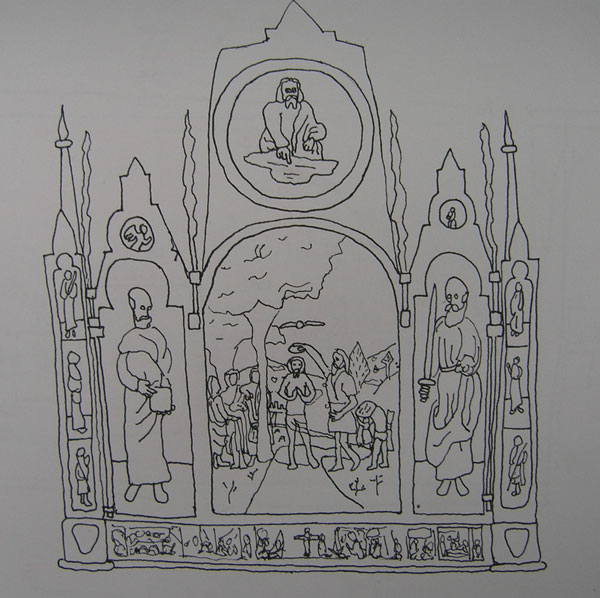
  3. B suppresses acknowledged function of 15th century privately commissioned paintings as allowing patrons to show off their education and sophistication to their peers in favour of Church commissioned pictures' didactic function (deliberate deception?). This is a privately commissioned picture. Note common feature of religions to encode two or more things in same story – one simple one for general population, another (often quite different) for elites.
  4. Related to 3 is that magical thinking was prevalent in the culture – systems of correspondences etc, including number symbolism. Given P's mathematical ability and friendship with people such as Nicholas of Cusa (which B might not have known about), elaborate geometrical symbolism is one of P's resources. Note limited nature of geometrical scheme B presents (another deception?).
  5. Related to 4 is P's early training as heraldic painter, which would have taught him to see the division of space as a way of conveying meaning (note that B could not have known this).
  6. B's insistence of purely formal solutions to problems seems unreasonable. It doesn't take account of 15th century iconography, nor of role of humanists in deciding iconographical scheme (related to 3 but in tension with 4 – resolve by arguing for P playing active role with humanists in deciding scheme (cf Arezzo)).
  7. Is a reductionist account (what you see is what you get) best way of dealing with good pictures, part of whose interest surely lies in the way they work at several levels? How does that fit with B's (disingenuous) acknowledgement that his not necessarily best way to look at pictures?

29 January 2008

Roads to nowhere

I’ve just got back from a couple of weeks in Ancient Rome. We had fun seeing the sights and all, but it all turned to custard when we went to a party with a bunch of Roman painters.

One of them quoted approvingly that old story about the painting competition where one painter painted some fruit and birds tried to eat it. Then they went to draw back the curtain covering the other painter’s work and discovered that the curtain was the painting. He won, because while the other guy had fooled birds he had fooled humans (which is not that difficult really).

I laughed and said what a stupid story that was. The Romans got all huffy and started quoting Aristotle at me. The exchange went something like this:

Me: ‘Bollocks to Aristotle. He was Alexander the Great’s tutor, and look how that turned out.’
Roman: ‘Yes, Alexander the Great conquered the known world!’
Me: ‘Exactly. The murdering bastard.’

Picabia intervened at this point. He tried reasoning with them and used the example of music. Aristotle reckoned art was mimesis. However, music doesn’t imitate anything. It is a purely abstract art. Picabia then tried to lead them through the way he developed abstract painting through the analogy with music. They just looked at him blankly.

I reckon the problem was with their assumptions. They assumed that Rome was centre of the world. All roads lead to Rome and all that. Because it was the centre of the world, it was necessarily the most advanced city in the world. And since they were Roman, they were the most advanced painters in the world, by definition. These assumptions actually made them very parochial and insular. They assumed they had nothing to learn from barbarians from the sticks, which is what they took us to be. Idiots.

Poor old Piero. He had all his illusions shattered.

Update: Well, I've just had Picabia on the phone. My first clue that he was a little irate was his opening line: 'You fucking idiot!' He thinks I misrepresented him in this post and wants me to stress that the the whole abstract painting through analogy with music thing only reflected his thinking for a short period between about 1911 and 1913. He moved on fairly quickly from there. (I won't quote him on the subject. He did go on for a bit.) The only reason he mentioned it to those Roman gits was because he thought they needed to start with the basics. Fair call. They didn't even get that.

I'm fairly sympathetic. He's a bit sensitive to being misinterpreted at the moment. You should've seen him after he'd read some of the stuff art historians had written about him, especially when he read the one who thought he'd ripped off Duchamp. Of course, it was the other way round. He was a little disappointed no-one realised Picasso ripped him off either (to say the least).

25 January 2008

Can't take them anywhere

I was hanging out with Francis Picabia and Piero della Francesca the other day. We’d gone to see the Fall in early 80s London, and Picabia was ranting about how punk rock just ripped off all the least important aspects of Dada and failed to get what it was really all about.

Piero had spent the day in the library reading up on what art historians made of his work. Apparently he got told off because he was laughing too loudly. We got into a bit of an argument about when was the best time to be a painter. Each of us maintained that we’d been born at exactly the right time.

Piero made the point that people were a lot more visually literate in his time than people in either Picabia’s or mine. He pointed out that a lack of standard weights and measures meant that people got really good at judging areas and volumes just from a single glance. He also mentioned that widespread illiteracy meant that the visual communication of ideas was a lot more important.

He used the example of gestures. In the 15th century there was an established vocabulary of gestures, with individual gestures having a highly specific established meaning that viewers in his time would understand. That’s just one example of the highly sophisticated system of visual symbols that were a part of the general culture. They didn’t need to be explained. Not knowing this vocabulary, we miss a lot of the meaning of Renaissance paintings and often misinterpret them. He went into some detail, but I missed a lot of it because I had to go break up a fight between Picabia and Mark E Smith.

03 September 2007

Graphic novel background notes

  • Picabia's wealth did come from a Cuban sugar plantation. He was very successful until Dada fell apart in the early 20s. He did indeed end up poor and critically maligned, though his reputation has been rehabilitated somewhat recently (one day I'll set out why I reckon he's the greatest artist of the 20th century and why I reckon Duchamp stole all his ideas). Several of Picabia's contemporaries remarked that he was a physical coward (except for when he was behind the wheel of a car). He much preferred egging other people on than doing things himself.
  • Claiming that Piero invented double-entry book-keeping is a bit of a stretch. History records that it was Luca Pacioli, who was Piero's pupil. However, Pacioli was accused of plagiarising Piero, and so I've assumed Pacioli stole the idea for double-entry book-keeping from Piero. It's also possible to interpret Piero's Baptism as being about the mystical significance of accounting.
  • Columbus fluked the right route to the New World. You need to hit the right latitude for the right prevailing winds.
  • We do indeed get barbecues, hammocks, and smoking tobacco for pleasure from the Taino. According to Peter Martyr, 'It requires so little to satisfy them that, in that vast region [Hispaniola, which I've named Libertaria], there is always more land to cultivate than is needed. It is indeed a golden age, [for] neither ditches nor hedges nor walls enclose their domains; they live in gardens open to all, without laws and without judges.' They were completely wiped out within decades of the Spanish's arrival.
  • Caciques (chiefs) and bohiques (priests) would take cohoba to cure illnesses, see the future, and talk to the gods. Before taking it, they would ritually purge themselves using specially carved wooden sticks. On cohoba, things appear upside down, movements and gestures are reversed, and you see shifting and intense kaleidoscopic colours. At the beginning of time, the gods overlaid the world with layers of geometric design that can only be seen on cohoba. Destructive spirits rip holes in this fabric and cause illness, crop failure, and hurricanes etc.
  • Although the Classic Mayan civilisation had collapsed a long time ago, there were still Mayan cities when the Spanish arrived. The Spanish did, on one occasion, get invited to dinner and then attacked. You'll find out why in the next instalment.
  • My working title is The New World: A revenge fantasy.
NB: If you click on the label 'graphic novel' you'll see the first two instalments. The third will probably not be posted till early next week, the way things are going.

06 August 2007

Painting

I have, I'll freely admit, been a bit slack on the old painting front of late. I've been distracted by such things as the busy time at work, giving a lecture and radio interviews, writing a couple of other things, being in a group show, starting a political party, the film fest, and other hijinks.

However, the holiday's over. First off I've got to complete some things that've been lying around for far too long. Here's a couple of (crappy photos of) them.

Piero and me:

Picabia and me:

This is one I prepared earlier, which I'm going to enter into the Wallace Award. It's Humanity won't be happy:
The title of the last one is taken from a revolutionary slogan. In its original formulation it was 'Humanity won't be happy until the last aristocrat is strangled with the guts of the last priest.' In the 20th century it was updated to 'Humanity won't be happy until the last capitalist is strangled with the guts of the last bureaucrat.' This makes it a very appropriate entry into the Wallace, I reckon.

05 June 2007

Why science fiction is the only legitimate art form of the 20th and 21st centuries

Good afternoon ladies and gentlemen. I’d like to begin with a quote by Philip K Dick from 1974:
How does one fashion a book of resistance, a book of truth in an empire of falsehood, or a book of rectitutude in an empire of vicious lies? How does one do this right in front of the enemy?

Not through the old-fashioned ways of writing while you’re in the bathroom, but how does one do this in a truly future technological state? Is it possible for freedom and independence to arise in new ways under new conditions? That is, will new tyrannies abolish these protests? Or will there be new responses by the spirit that we can’t anticipate?

By only legitimate art form, I mean that which exemplifies the culture, the place and time in which the artwork is made -– the zeitgeist if you will, the spirit of the times. For example, in the 15th century, Western culture’s sudden new access to Arab maths and Greek science caused deep societal and cultural change. New continents were discovered and double-entry bookkeeping was invented.

’Man is the measure of all things’ was the new credo, as exemplified by perspective painting, where the average height of a man was literally the measure used to create pictorial space. If we compare a 15th century painting that’s still in the International Gothic style...

...with Piero della Franscesca’s Flagellation...

...it should be obvious which is the legitimate 15th century artwork.

We live in an advanced capitalist society, one that is only made possible through perpetual advances in technology. We need technology to advance simply to maintain the society that we have. This is an incredible thing. The industrial revolution represents a radical break with the past. Previously, every generation basically lived the same kind of lives as their parents and grandparents. Change happened on a much longer timescale. Let’s watch our first film. As well as being a nice illustration of how science fiction exemplifies our culture, it also shows how much things have changed in just half a lifetime. [Caltex ad]

We live radically different lives than practically all of our ancestors, pretty much mostly cos we have artificial lighting and regular clocks. Modern cities never sleep. There’s always someone up doing something. We are taller and we live much longer and easier lives than most people who have ever lived. Of course, all this comes at a cost. Two hundred years of industrialisation has stripped out virtually all of the readily accessible minerals and oil, wiped out a significant proportion of the world’s species, and fucked the climate for at least the next few thousand years.

By advanced capitalist society, I mean of course that we are now a consumer-driven post-industrial capitalist society. As the avant-garde art political group the Situationist International identified in the mid-50s:
The project of the postwar West is to redefine everyday life to mean the pleasurable consumption of material goods in a system of male supremacy and corporate hegemony.

This is the 50s future that we inhabit.

Like the revolution, the science fiction future – jet packs and holidays on Mars, an end to poverty and disease and work, and our descendents spreading out among the stars – was never going to happen.

Science fiction has always been about using metaphors of a technological future to talk about modern life now. Although it originated in the European avant-garde, as I will shortly demonstrate, it really came into its own in mass-produced pulp fiction and film – two media that couldn’t exist without industrial capitalism – so that with science fiction you get that magic marriage between form and content that produces great art. As Philip K Dick said in 1969:

[I]t embodies some of the most subtle, ancient, and far-reaching dreams, ideas, and aspirations of which thinking man is capable. In essence, it’s the broadest field ... permitting the most far-ranging and advanced concepts of every possible type; no variety of idea can be excluded from SF; everything is its property.

Let’s watch our second film, by Dunedin animator Fred O’Neill. [Fred O’Neill]

Some recurring science fiction images – robots and spaceships, pocket communicators and computer terminals that can access all of human knowledge – are now a part of our everyday life. In a lot of ways, science fiction has formed our world. Take the rocket ship, the ultimate metaphor for the American love affair with the motorcar, itself a quintessential modern thing. The visual metaphor of the rocket informed the design of 50s cars, huge things that were all fins and swooping lines, creating a feedback loop that’s continued to the present day. Just look at my Star Trek communicator! [Wave cellphone around.]

As I mentioned before, all this had its origin in the avant-garde art movement of the early 20th century. In 1904, while still an art school student, Francis Picabia, who would go on to paint the world’s first ever abstract painting five years later, declared:
One day all of us young painters ... will be the masters of Paris and turn the Champ Elysees into an immense playground. In circles, in serried rows, delimited by geometrical figures, we will set up all the plaster casts of the schools, all the marbles of the Louvre, the statues of the gardens and museums. And then the astonished bourgeoisie will see something unique. With a fusillade of stones we will demolish the Discobulous, the Belvedere Apollo, the Venus de Milo, and the Venus de Medici.

As usual, artists were the first to see the way things were. For the first time ever, the Golden Age moved from the past into the future. Rather than being dispensed by gods, we would use technology to transform ourselves into gods.

In 1909, the Italian poet Marinetti published the Futurist Manifesto and went on a highly successful speaking tour of Europe. The Futurists glorified speed and technology – Marinetti wrote ecstatically about crashing his car, prefiguring J.G. Ballard – and, just like the student Picabia, wanted to destroy the art of the past and start afresh, create a modern art for a modern society.

In Moscow in 1913, the only performance of the Russian Futurist opera Victory over the sun ended in riots. In it:
[T]he sun, representative of the decadent past, is torn down from the sky, locked in a concrete box, and given a funeral by the Strong Men of the Future. The Traveller in Time appears to declare the future is masculine and that all people will look happy, although happiness itself will no longer exist. Meanwhile, the Man with Bad Intentions wages war and the terrified Fat Man finds himself unable to understand the modern world. The opera ends as an aeroplane crashes into the stage.

Kasimir Malevich, most famous for his one-man Suprematist art movement, designed the costumes and backdrops for the opera.

In 1919, he wrote:
One needs but to find the mutual relationships of two bodies moving in space; the earth and the moon; between these two, there may be constructed a new Suprematist satellite, equipped with all the elements, which will move in orbit, shaping its new path. In analysing Suprematist form in motion, we come to the conclusion that movement along a straight line towards any planet may be conquered in no other way than by circular movement of interstitial Suprematist satellites that form a straight line of circles from satellite to satellite.


Of course, between 1913 and 1919, technological progress reached its logical conclusion in the horrific mass murder that is industrialised warfare, something else never before seen on the face of the earth. As a result, the cyborg was born.

The Dada movement was a response to this madness. In Berlin, Raoul Hausmann and Hannah Hoch invented photomontage, a new visual medium that transformed the dominant society’s industrially produced propaganda and advertising into art.

George Grosz incorporated the technique into his paintings, explicitly portraying the plight of modern man using the metaphor of an android.

In New York, which he described as ‘the cubist, the futurist city’, Francis Picabia had worked through abstraction to a new mechanomorphic style.

Here he portrays the human condition as machines that fail to connect, endlessly repeating the same hopeless motions, going and getting nowhere, just like in a Philip K Dick novel.

People generally consider Dada to be a precursor of Surrealism, but that’s bollocks. Its true successor was Constructivism. The Constructivists also wanted to transform society into a technological utopia. They made no distinction between advanced art and everyday objects, such as chairs and tables. Here’s Tatlin’s Monument to the Third International, a true science fiction extravaganza.


Tatlin’s Monument was:
...to be built from industrial materials: iron, glass and steel. In materials, shape, and function, it was envisioned as a towering symbol of modernity. It would have dwarfed the Eiffel Tower in Paris. The tower's main form was a twin helix which spiraled up to 400 m in height, which visitors would be transported around with the aid of various mechanical devices. The main framework would contain three enormous rotating geometric structures. At the base of the structure was a cube which was designed as a venue for lectures, conferences and congress meetings, and would complete a rotation in the span of one year. In the centre of the structure was a cone, housing executive activities and completing a rotation once a month. The topmost one, a cylinder, was to house an information centre, issuing news bulletins and manifestos via telegraph, radio and loudspeaker, and would complete a rotation once a day. There were also plans to install a gigantic open-air screen on the cylinder, and a further projector which would be able to cast messages across the clouds on any overcast day.

After World War II, which brought its own delightful technological innovations, modern art got hijacked by the CIA, which kind of fucked it for a while.

However, rather than dwelling on that, let’s have a look at Len Lye’s Birth of the Robot, which has a really nice juxtaposition of classical and modern motifs and which sums everything up nicely. [Len Lye]

Okay, I’ll finish with a new generation of NZ artists who are using science fiction forms to talk about their interests and concerns, and then, if we’ve got time, I’ll answer any questions.

First, we have Andrew McLeod.

This is by Brendon Wilkinson [slide 11]. When I was researching this talk, I came across this quote by Brendon: ‘For me, surrealism and science fiction are the only interesting things to come out of the 20th century, in terms of art.’

This is by Yvonne Todd.

Here we have Matt Hunt.

Here’s Paul Faris.

This one’s by Stephen Clover.

Finally, this is one of mine. It’s called Signs of a doomed civilisation.

Any questions?

[NB: These are the notes and slides from the talk that I gave at the New Zealand Film Archive on 2 June at the instigation of Mark Willams. I'd like to acknowledge both Mark and Anna Dean of the Archive, without whom this would not have been possible.]

27 April 2005

Piero della Francesca timeline

1411–13?
Born in Borgo San Sepolcro. Father Benedetto della Francesca, owner of a shoe-making business, mother Romana di Carlo da Monterchi.

1420s
Piero goes to abacus school, then is apprenticed to heraldic painter Antonio d’ Anghiari.

1432
Payment by Antonio d’ Anghiari to Piero as a painter in his own right.

1437–38
Piero working with Domenico Veneziano in Perugia. On 8 January 1438 Antonio d’ Anghiari settles all debts to Piero and moves to Arezzo.

1439
Piero in Florence with Domenico Veneziano, where he sees lots of influential stuff, including council between Western and Eastern churches to deal to the Turks, and could possibly have met Leon Battista Alberti, whose On Painting he has probably read.

1445
Piero signs contract for Misericordia altarpiece.

1447
Piero and Domenico Veneziano on a commission in Loreto that is cut short by plague.

1450
(Possibly from 1448) Piero in Ferrara working for Borso d’ Este, where he meets Rogier van der Weyden. Also possibly in Rome for Holy Year. Paints St Jerome Penitent and writes On the Abacus.

1450–55?
Piero paints St Jerome and Devotee and Baptism.

1451
Piero in Rimini working for Sigismondo Malatesta on fresco for Tempio Malatesta.

1453
Piero issued with crossbow and takes part in practice battle in case of war between Florence and king of Aragon.

1454
Piero signs contract for Sant’ Agostino altarpiece.

1455
Writ served on Piero in absentia ordering him to return to Borgo within 40 days to complete the Misericordia panels or forfeit advances.

1456
Battles with the Turks on the Danube possibly provide iconographical scheme for Arezzo cycle.

1457–58
Piero does preliminary work on Arezzo cycle: cartoons, some heads.

1459
Piero in Rome working for Pope Pius II, paints St Luke the Evangelist, but leaves for mother’s funeral.

1460–66
Piero completes Arezzo cycle.

1460
Piero member of the civic reform commission in Borgo. Paints Madonna del Parto.

1463–64
Piero paints Flagellation.

1464–66
Piero in Arezzo. In 1465 Piero and his brothers Marco and Antonio are gifted a house in Borgo.

1465–70?
Piero paints Sant’ Antonio altarpiece (finished in 1468), Sant’ Agostino altarpiece (finished in 1469), Hercules and Resurrection.

1466
Piero paints Mary Magdalene, St Julian, and St John the Evangelist.

1468
Piero and his brothers Marco and Antonio buy more property. Piero in Bastia to avoid plague.

1469
Piero in Urbino to assess panel by Uccello on behalf of Giovanni Santi (Raphael’s father).

1470–80?
Piero writes On Perspective in Painting.

1472–74
Piero paints Brera altarpiece for Federico da Montefeltro.

1472
Piero in Borgo as part of body that appoints doctor.

1474
Piero paints portraits of Federico da Montefeltro and Battista Sforza. Directs fortification work in Borgo.

1475–80
Piero prior of San Bartolomeo confraternity.

1478–80
Piero paints Senigallia Madonna.

1482
Piero rents furnished house and kitchen garden in Rimini.

1483–87
Piero paints Nativity.

1486
Piero writes On the Five Regular Bodies.

1487
Piero writes will.

1488
Piero pays niece’s dowry.

1492
Piero dies.

07 March 2001

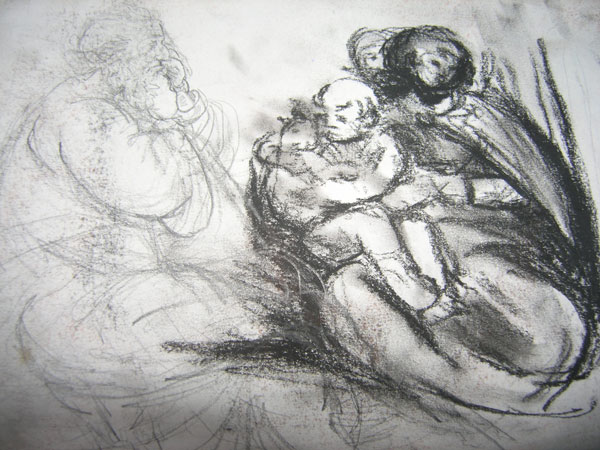
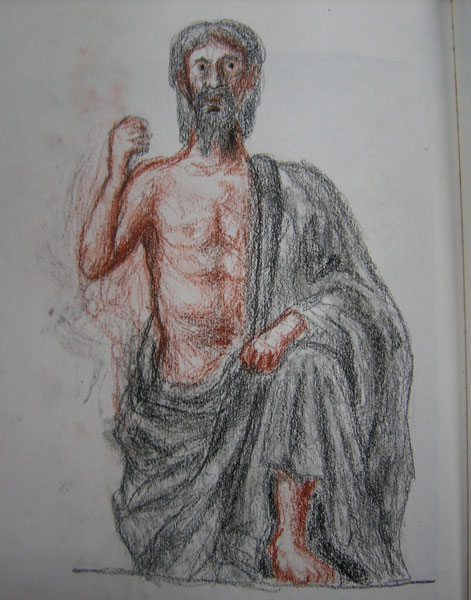
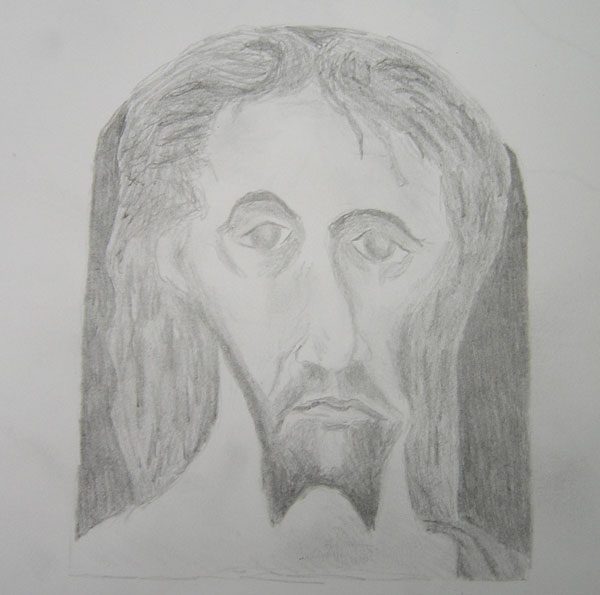
Some old drawings

Ripping off Leonardo da Vinci:


Ripping off Piero della Francesca:

Ripping off Mark Tansey:

Ripping off Leon Battista Alberti:

Ripping off Tony Fomison ripping off Piero:

Ripping off Philip Guston:

General fist waving:

Reconstruction of Piero's Baptism:

Vive le vol!
visitors since 29 March 2004.